Friday, August 06, 2021

Jim likes sunsets

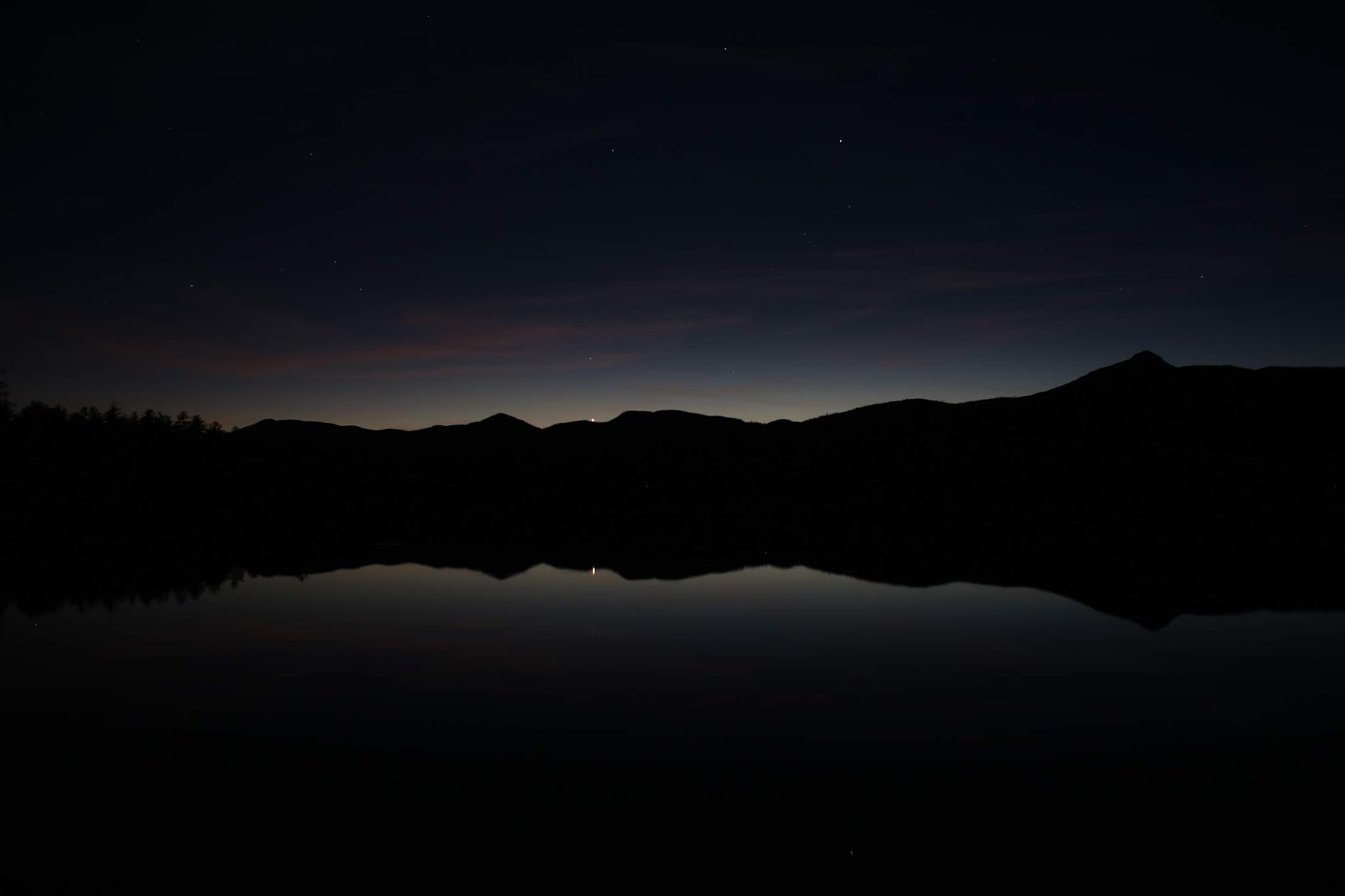
Mount Chocorua from Page Hill, 20:07 4 Aug '21

Here in the great northern wilderness of New Hampshire, we have had several nights of spectacular sunsets. This is one of the images. It is unadjusted, apart from lens corrections!


Camera equipment
Canon Mark III EOS 5d
Canon EF28mm f/1.8 USM
Photo details
1/60", 28mm, f/4.0, ISO 100


I call this image "Wild nights", after the poem by Emily Dickinson. 

Wild nights - Wild nights!
Were I with thee
Wild nights should be
Our luxury!

Futile - the winds -
To a Heart in port -
Done with the Compass -
Done with the Chart!

Rowing in Eden -
Ah - the Sea!
Might I but moor - tonight -
In thee!

This poem has great significance to me, in large part because of its musical context.  In 1991 we moved from a small town in Maine to a small town in Oregon. The previous two years had not been kind to us both personally and professionally. We had moved rather suddenly from one coast to the other, hearts breaking in all four of us as we said goodbye to friends and drove ourselves and all of our belongings to a new home thousands of miles away. Everything precious to Maureen and me was on that truck.

I was in the second year of an appointment as an associate professor of theoretical chemistry in a small college in Oregon, in wine country, southwest of Portland. My research was off to a good start. I enjoyed my classes, and my new colleagues encouraged me to pursue my interests outside of the sciences. Maureen had just found a position as a dietician at Oregon Health Sciences University. as it was then known. We were emerging from the darkness into new schools and friendships.

I was quite fortunate to join the Portland Symphonic Choir in its 1992-1993 season; Maureen joined the following year. The choir performed regularly with the Oregon Symphony, at the time conducted by James DePreist, nephew of the contralto Marion Anderson. In the usual inexplicable resonance of the cosmos, the maestro and Maureen shared birthdays. Singing with the symphony added a level of richness, achievement,  and personal satisfaction that was a welcome balm on the rough edges of our souls, and the prospect of happiness that had seemed distant only two short years earlier.

The maestro always pointed Marion Anderson out to us. "Aunt Marion" was a presence dressed in white, high in the upper balcony where the sound was best. Jimmie, as he was known to all, relayed her criticisms after each rehearsal.

The first work performed by the choir that season was Beethoven's "Choral Fantasy", with Garrick Ohlsson at the keyboard, the season opener and gala concert. Garrick was a huge man, towering over all of us, kind to all and a delight on stage. The Beethoven is an early musical sketch of what became the fourth movement of the 9th symphony, with its choral setting of Schiller's "Ode to Joy".

The second major work as John Adams' setting of three poems by John Donne and Emily Dickinson, "Harmonium"
"Negative Love" (by Donne)
"Because I could not stop for Death" (by Dickinson)
"Wild Nights" (by Dickinson)

On 15 April 1981, the work was premiered by the San Francisco Symphony and Symphony Chorus, Edo de Waart at the baton. The work requires large forces. This 1992 production was the first performance of the work on the West Coast after the premiere. The composer would be in attendance. Maestro James DePreist would be conducting the orchestra, and only three rehearsals with the orchestra.

There was no segue between the two Dickinson poems; the music leaped from one to another, with several intense orchestral passages. The tempi were fast, the tessitura were very high and fortissimo, and the orchestra was blasting away. And the music itself was challenging. The maestro had a strategy to help keep the chorus anchored to the music: he would raise his left hand and hold it for a full measure; there were three points in the last movement where he did this. 

Each choral rehearsal - there were many - I left work, inhaled dinner, drove to Portland, rehearsed for two and a half hours or more, then drove home, then finished grading and class preparation for the following day, working sometimes till dawn. I was sustained by the beauty of the music and the poetry.

The performances were thrilling. Audiences thundered their approval. The maestro beamed and praised the entire ensemble. The composer was pleased. The maestro said Aunt Marion was satisfied but our diction could be better. Maureen and Greg and Kate came to one performance. 

I would hear again and again in my mind the closing lines,  followed by the soft weeping voice of the brass and the French horns:

Rowing in Eden - | Ah - the Sea!

Might I but moor - tonight - | In thee!

Here is a link to an excerpt from the San Francisco Symphony's recording of the last movement, with commentary by the British conductor Sir Simon Rattle.

Ah - the Sea!

Climate shite hitting the climate fan

 The Guardian reports

Here's the story:

Climate crisis: Scientists spot warning signs of Gulf Stream collapse

A shutdown would have devastating global impacts and must not be allowed to happen, researchers say

"Climate scientists have detected warning signs of the collapse of the Gulf Stream, one of the planet’s main potential tipping points.

The research found “an almost complete loss of stability over the last century” of the currents that researchers call the Atlantic meridional overturning circulation (AMOC). The currents are already at their slowest point in at least 1,600 years, but the new analysis shows they may be nearing a shutdown.

Such an event would have catastrophic consequences around the world, severely disrupting the rains that billions of people depend on for food in India, South America and West Africa; increasing storms and lowering temperatures in Europe; and pushing up the sea level off eastern North America. It would also further endanger the Amazon rainforest and Antarctic ice sheets."

Read on, Macduff.*

*The actual quote from the Scottish play is "Lay on, Macduff", Act 5, Scene 7.

Macbeth I will not yield To kiss the ground before young Malcolm's feet, And to be baited with the rabble's curse. Though Birnam wood be come to Dunsinane, And thou, opposed, being of no woman born, Yet I will try the last. Before my body I throw my warlike shield. Lay on, Macduff, And damned be him that first cries, 'Hold, enough.'

Sunday, July 25, 2021

Moonset over Tamworth - Guest post by Jim

[O.G.: Here's another guest post by Jim, in Tamworth NH]

I got up in the middle of the night to photograph the full buck moon setting over Tamworth. The weather prediction had been for clear skies, but when I looked out the window at 4 AM, the house was in fog. I went back to bed wondering.

Half an hour later, the bright moonlight woke me up. I was ready in ten minutes. I had planned to take only my camera, but since I would be stomping through uncertain terrain, I took my tripod as well. I drove a mile down Page Hill to the new clearing made by Deb and Chris Franchi, with its spectacular views to the west and north along the entire Sandwich range.

Bringing the tripod was a good decision, because I spent nearly an hour at the site. Holding up a long lens for an hour would not have been fun. I made my way to a point where I could see the white steeple of the Congo church in town.

The moon was bright and clear high above the horizon, but the fog at ground level swirled through the town, and the moon had taken on a dark red hue, probably from the fires in Canada and out West that have made our skies more polluted than usual.

I always enjoy these solitary hours, because I am never truly alone. We are long-time members of the Church of the Great Outdoors - it is a demanding religion that requires daily participation in its rites.  So I was attending today's religious service, in the company of diverse flora and fauna. The flowers were just waking up, still covered with dew. The bird life around me was its usual early morning racket, the avian matins filled with cries from the chickadees, the thrushes, the vireos, the crows, the doves, and the occasional owl. And the light breezes through the trees added a delicate percussion to the birds' symphony. One solitary car passed above me on the road in that entire hour.

Photo: Tamworth, Bunker Hill, Red Hill,  and moonset, 5 AM 24 July 2021

This image is of the moonset over Tamworth, with Red Hill and its fire tower 13 miles away visible in the distance, with the ridge line of Bunker Hill in between. The white tower of the Congregational Church pokes through the fog in the foreground.

Equipment:is title
Canon 5d Mark III EOS
Sigma 150-600mm F5-6.3 DG OS HSM | Contemporary 015 + 1.4x
photo detailsis second
1/200", f/6.0, ISO 2000
 

I have a poem in mind for this morning, one by ee cummings: "who knows if the moon's ...", a poem from his second volume of poetry, &, self-published in 1925 and set to music by Dominic Argento thirty years later. There is a back-story to the title of that poetry volume. His first book of poetry, Tulips and Chimneys, had been published by Thomas Setlzer in 1923. The poet was unhappy that his title, Tulips & Chimneys, had been tossed aside, so in 1925 he put together his own printing of works deleted from his first volume, and called his second volume &. Take that, Mr. Thomas Seltzer!

who knows if the moon's
by ee cummings, from &, 1925


who knows if the moon's
a balloon,coming out of a keen city
in the sky--filled with pretty people?
( and if you and I should

get into it,if they
should take me and take you into their balloon,
why then
we'd go up higher with all the pretty people

than houses and steeples and clouds:
go sailing
away and away sailing into a keen
city which nobody's ever visited,where

always
it's
Spring)and everyone's
in love and flowers pick themselves

[O.G.: Thanks, Jim]

Tamworth, Bunker Hill, Red Hill,  and moonset, 5 AM 24 July 2021


Tuesday, July 06, 2021

Full moon over Tamworth

 Jim sends a couple more of photos from 24 June, as the full moon rose.

He writes:

These were taken from the Great Hill Firetower looking to the village of Tamworth and the rising moon. Low-lying clouds obscured moonrise until the moon rose a few degrees above Ossipee Lake in the distance, above the summit of Welch Top (422m).

I was inspired by John Updike’s poem.

June
by
John Updike

The sun is rich
And gladly pays
In golden hours,
Silver days,

And long green weeks
That never end.
School’s out.
The time Is ours to spend.

There’s Little League,
Hopscotch, the creek,
And, after supper,
Hide-and-seek.

The live-long light
Is like a dream,
and freckles come
Like flies to cream.

Equipment:

Canon Mark III EOS 5d

Sigma 150-600mm F5-6.3 DG OS HSM|Contemporary 015+1.4x


(A)1/250", 210mm, f/71, ISO 10000 

(B)1/250", 840mm, f/9.0, ISO 10000

The small white dot at 8:00 and about 1 lunar radius is the double star HD 171595, 151 ly away in Sagittarius, enhanced with a small radial filter increasing the exposure around the star by +4.00.


Mini Review: Our Biggest Experiment: An Epic History of the Climate Crisis

 The Guardian recently ran a long-read,

Sixty years of climate change warnings: the signs that were missed (and ignored)

The effects of ‘weird weather’ were already being felt in the 1960s, but scientists linking fossil fuels with climate change were dismissed as prophets of doom

Here is a blurb of the book from which that was extracted:

 ‘Our Biggest Experiment recounts how the world became addicted to fossil fuels, how we discovered that electricity could be a savior, and how renewable energy is far from a twentieth-century discovery. Bell cuts through complicated jargon and jumbles of numbers to show how we're getting to grips with what is now the defining issue of our time. The message she relays is ultimately hopeful; harnessing the ingenuity and intelligence that has driven the history of climate change research can result in a more sustainable and bearable future for humanity.’

Here is our friend Jim's view:
That message of hope is surely a hope in vain, given our current politics. But climate books with a message of despair don’t sell very well, although they do seem to drive up consumption of ethanol and other forms of self-medication.
Here is my prediction: we will do little to avoid climate crises until a heat wave kills a few million, as in the opening scenario in Kim Stanley Robinson’s “The Ministry of the Future”. After that one nation or two will act to protect itself by adding SO2 to the stratosphere. This initially covert act will be sanctioned by the UN, reluctantly at first, and eventually enthusiastically encouraged by the corporations still invested in fossil fuels in 2040.
By 2060, two decades of this kind of climate modification will have killed most fish in the oceans and reduced crop yields, so the clamor will grow to end climate modification and focus on direct atmospheric capture of greenhouse gases.
That is as far on a limb as I care to go, but I do think that is a very likely outcome of our current lack of policy. Does that sound like a message of hope? Not to me.

We are of the same mind. However, the long-read and presumably the book are more factual, and sufficiently detailed for a retrospective assessment sixty years later. I am looking forward to the publication in the fall.

Monday, June 21, 2021

Another photo from Jim

Jim in Tamworth posted this photo for the solstice. 
He wrote: 

Ciao, amici Here is a photo for tonight's summer solstice at 23:31; I've included an excerpt from Seamus Heaney's solstice poem, "A dream of Solstice". 

It refers to the winter solstice, but the sun stands still at both. 

I love Heaney's use of the quote from Dante too. I do remember most of my dreams but there are times when I only remember the feeling, as does Dante's dreamer. 

About the photo This was the scene that greeted us as we returned from our first post-pandemic trip to visit our grandson and family in Wisconsin. The mountains, the clouds, the drama in the sky really said to us 'welcome home.' The photo reflects not just the physical beauty of the landscape, but also our turbulent feelings after not seeing our daughter and her family for so long, like all of us separated from family by the pandemic. 

Ciao, 
Jim 
 
Photo details: 
"Overboiling clouds", 15 June '21, 19:13 
Canon Mark III EOS 5d, Canon EF28mm f/1.8 USM 
1/80", f/4.5, ISO 100 
Mount Chocorua under a dark sky, looking north from Page Hill 

 Excerpt The Irish Times, 21 Dec 1999 A Dream of Solstice by Seamus Heaney https://www.irishtimes.com/news/a-dream-of-solstice-1.263283
Qual è colüi che sognando vede, 
che dopo 'l sogno la passione impressa rimane, 
e l'altro a la mente non riede, 
cotal son io... 

 Dante, Paradiso, Canto xxxiii 

 [Just as the dreamer, after he awakens, 
still stirred by feelings that the dream evoked, 
cannot bring the rest of it to mind, 
such am I…] 

And as in illo tempore [in that time] people marked 
The king's gold dagger when he plunged it in 

To the hilt in unsown ground, to start the work 
Of the world again, to speed the plough 
And plant the riddled grain, we watch through murk 
And overboiling cloud for the milted glow 

Of sunrise, for an eastern dazzle 
To send first light like share-shine in a furrow 
 Steadily deeper, farther available, 
Creeping along the floor of the passage grave 

To backstone and capstone, to hold its candle Inside the cosmic hill…

Sunday, June 28, 2020

Jim had another interesting photo

We heard from Jim in Tamworth:
I was successful, after several frustrating nights, doing some night photography last night. 
Here's my favorite image. This is not the setting sun. This was taken at nearly midnight. The setting moon to the west lighting up the cloud, the star field - those are stars, not specks of dust - faint through the clouds, and a FIREFLY
flying through the scene with the shutter open, 7 flashes in 8 seconds, glowing for about 1/10 sec! 
It was difficult shooting in the dark, with the moon moving in and out of the clouds, and not knowing the terrain. I said to Maureen that the real problems with night photography are that you have to do it at night. 
Enjoy. Jim 
Photo details, Canon Mark III EOS 5d, 8 secs, Canon 24-105 mm zoom at 105mm, f/4.0,exposure increased in production to f/2.50, ISO 10000, shot at 23:55, 26 June 2020 from White Gates Farm, Tamworth NH
Thanks, Jim. Nice photo!

Wednesday, May 27, 2020

Jim has a new neighbor

From our friend in Tamworth NH:
“ Here's a dad we hope is starting a family here.
Photo details: Canon Mark III EOS 5d, Vivitar 600 mm,1/40”, f/8, ISO 160, tripod mounted, cropped

Friday, May 22, 2020

Venus on the half-shell

Our friend Jim has a picture from Tamworth, NH.

He wrote “I call this photo "Venus on the half-shell". Apologies to Kurt Vonnegut. Here is Venus as it sets over the Sandwich range between Mount Passaconaway and Mount Paugus,at about 21:10 last night, mirrored below in Chocorua Lake, as seen from the Narrows Bridge. Completely unedited.”

Nice photo, Jim.

Wednesday, May 20, 2020

Guest post: Jim remembers his year in Beijing

Our friend Jim has another post for us. He talks about his year in Beijing.
——————————————————

For twenty six years, I was a chemistry professor at Linfield College, in the heart of Oregon wine country, and in the middle of House District 1, a Congressional seat then held by Democrats since 1975. While we lived in Oregon, OR-1 representatives included Les AuCoin (‘75-‘93), Elizabeth Furse (‘93-‘99), David Wu (‘99- Aug ‘11), and  Suzanne Bonamici (Aug ‘11-present). 

Les AuCoin was opposed to all of Reagan’s Central American policies. He was highly regarded in the district. In 1992, he ran unsuccessfully for the Senate against incumbent Bob Packwood. That is another story.*

Elizabeth Furse came into office on Clinton’s coattails, squeaked by in the ‘94 ‘Contract on America’, and won another narrow race in ‘96. She had developed a reputation as a good supporter of health care, especially diabetes. Oregon Health and Sciences University was and is a major hospital in the Portland metro area and, at the time, ran a chain of dialysis clinics throughout the House district*, and benefitted from Furse’s support. Furse declined to run for a fourth term. She had made several perplexing statements during her last term and might have faced a tough primary challenger. Linfield gave her an honorary degree in ‘95(?) and her remarks were more than a bit odd.

In the fall of ‘98, David Wu ran against Molly Bordonaro, a young socialite with extreme right-wing views, with no experience aside from running for the ‘96 GOP nomination for OR-1, and no qualifications other than a checkbook and a wealthy father. In predictable fashion, Portland’s major newspaper, the Oregonian (whom even its staffers referred to as the bOregonian), endorsed Bordonaro, calling her ‘a fresh young face’. She lost, 47% to Wu’s 50%. David Wu was the first native of Taiwan to be elected to the House.

While in office, Wu developed strong ties to local technology firms, environmental organizations, and pro-choice organizations. He supported funding for the Tualatin National Wildlife Sanctuary. He and then Congressman Brian Baird (WA-3) worked together to create the Lewis and Clark National Historic Park at the mouth of the Columbia River. He had active roles on the House Committees on Education and Labor, and Science, Space, and Technology. He came to be regarded as a moderate-to-progressive Democrat with a good relationship with his district.

My life took an amazing turn during my sabbatical in 2008-2009, which I spent working in the laboratory of my former student and now colleague in the National Center for Nanoscience and Technology in Beijing. I had no previous language experience with Asian languages, so learning to speak, read, and write, initially at the baby level, took a great deal of effort. My year in Beijing was a great experience, and one that would be impossible in today’s political climate. Beijing is very different now than it was in the year of the Olympics. 

I co-authored four articles with my colleague and his graduate students. I was a Western voice for a Korean mobile phone company. I sang with the Beijing International Festival Chorus, performed twice in the Forbidden City Concert Hall, and with the Deutcheschor Pekin, singing at the German Embassy and nearby German school. One of my favorite memories was being served a glass of glüwein by the German ambassador to China after we sang Christmas carols, in German of course, including favorites from my childhood.

I hired a Chinese tutor from Beijing Culture and Language University, eventually developing a vocabulary of perhaps 2000 words in speech, perhaps 1000 characters in reading, and maybe 500 characters in writing. I was like a new first grade student, except their accents were better! I made three TV commercials - one as a scientist, hawking a quack cure! - and was cast as Victor Hugo in a two-hour mini-series on Chinese cable TV. 

I travelled with my wife during her all-too brief visits to the mainland. We went to both Jinan - my colleague’s home town -  and Xi’An; I spent Spring Festival in Harbin with one of my housemates; I travelled to Chengdu with my official scientific sponsor from the Chinese Academy and spoke on “Scientific Writing in English” at the Chinese Academy of Engineering Physics in Mianyang - similar to our Los Alamos National Laboratory. In my role as a scientific consultant, I visited both Jinan and two biomedical institutes in Guangzhou with my colleague.

In addition to my scientific duties, as a favor to the nanocenter students, I taught a weekly seminar on less familiar aspects of US history and culture. My students did want to learn about the arts and especially  American music  - alas, my preferences for classical music did not serve me well there. More for convenience than any other reason, I used the online version of Howard Zinn’s “A People’s History of the United States” as the history reference. I also used whatever I could from more traditional sources, but they had to be accessible from behind the Great Firewall of China, a difficulty that could be evaded with a VPN - all the grad students knew how to do this. 

The grad students were, to a person, horrified by the history of abuse of  Chinese workers in the US, especially by the Robber Barons and their agents. But nothing came even close to the anger and resentment they had about the worst piece of legislation ever put on the books in the US - the Chinese Exclusion Act of 1882. Even though it had been repealed in 1943, it was still in the Code of Federal Regulations. We talked frequently about US policy towards Cuba - there were three Cuban grad students, hand picked by Raoul himself - and the legacy of the Chinese Exclusion Act.

I returned to Oregon after my sabbatical in the fall of 2009. In the spring of 2010, Linfield’s Political Science department sponsored a “Pizza and Politics” event with Congressman David Wu. He and I chatted for a few minutes, and I mentioned my experiences with the grad students in Beijing, especially their horror at the Chinese Exclusion Act. He said he had a personal goal of expunging that act from the CFR and wherever else it might lurk within the federal government.

Unfortunately, before that came about, both The Oregonian and Willamette Week, and independent weekly, reported Wu had  exhibited odd behavior and clashed with his staff in the midst of apparent mental illness during the 2010 election. 

The congressman resigned from office, in mid-term, 3 August, 2011, for personal reasons. 

Suzanne Bonamici won the Democratic nomination for the seat, 8 November 2011, and defeated Republican nominee Ron Cornilles in the special election on January 31, 2012.*

*Full disclosure: 

A friend produced the Portland, Oregon staging of The Packwood Diaries, written by Village Voice reporter Karen Houppert and her husband and play director Stephen Nunns. It was hilarious.

My wife worked as a nutrition support supervisor for OHSU’s dialysis clinics until they were privatized.

Our son worked for the initial Bonamici campaign in the nomination and subsequent special election and has remained active in Democratic Party politics. He most recently was the COO of Julián Castro’s presidential campaign. He is now working as an independent consultant.

——————————————————
Thanks for this shyte , Jim!

Monday, May 18, 2020

Guest post: You must see this film

Our friend Jim recently posted this on what he calls “the Zuckerberg entity.” Follow his advice. This is a great film.

————————————————
This is a film you must see, and must tell everyone you know to see.

This is a story about real heroes, a story that will make you weep, that will make you glad to know that such people have walked the earth. This is the story of the Gwangju Democratic Movement and the murder of hundreds of civilians by a corrupt dictator, an ally of the USA, the brave West German reporter who exposed the regime’s crimes to the world, and the astonishing taxi driver who made the reporting possible.

On 18 May, 1980, forty years ago today, the repressive dictator, Chun Doo-hwan orchestrated the murder of hundreds of civilians, mostly students, who were demonstrating against the martial law government. For this, he was called "The Butcher of Gwangju" by many people, especially among the students.

Chun had become the de facto leader of South Korea at that time since coming into power on December 12, 1979, after he led a successful military coup of the previous South Korean government, and seen to the murder of the previous dictator.
Source: , Gwangju Uprising

“The Butcher of Gwangju” was invited to the US by The Great Prevaricator. ‘At the invitation of President Ronald W. Reagan, the President of the Republic of Korea and Mrs. Chun Doo Hwan made an official visit to Washington, D.C. from February 1 to 3, 1981. ‘

We lived in LA at the time. I remember the local CBS anchor, Connie Chung, gushing over this visit by one dictator to meet with our own reactionary leader, who was just getting started murdering leftists in Central America. She made no mention of the Gwangju murders.

This has already happened at the end of the Carter administration: ‘On December 2, 1980, members of the Salvadoran National Guard were suspected to have raped and murdered four American, Catholic church women (three religious women, or nuns, and a laywoman). Maryknoll missionary sisters Maura Clarke and Ita Ford, Ursuline sister Dorothy Kazel, and laywoman Jean Donovan were on a Catholic relief mission providing food, shelter, transport, medical care, and burial to death squad victims...

the [Carter] administration claimed that the regime had taken "positive steps" to investigate the murder of four American nuns, but this was disputed by US Ambassador, Robert E. White, who said that he could find no evidence the junta was "conducting a serious investigation."  

White was dismissed from the foreign service by the Reagan Administration after he had refused to participate in a coverup of the Salvadoran military's responsibility for the murders at the behest of [Reagan administration]  Secretary of State Alexander Haig. ‘ 

For more about the film, see IMDB: A Taxi Driver

————————————————
Thanks, Jim!

Friday, March 27, 2020

life in a bad sci-fi movie

Yesterday I went to the local Hannafid’s. There were about half local, about half out-of-state plates, very much like the summer. I wore gloves and a mask, and took no bags.

As has been the case for the last three weeks, no TP (really?), no sanitizer, no dried beans, very limited pasta, very limited rice, no tofu (WTF?).

About half the shoppers wore masks and glove, as did I. Half did not. I said nothing. Clerks were friendly., helpful, and maintained distance.

I found 2 L of a ready-to-use disinfectant spray (a blend of 4 different quat NH4 compounds) at a hardware store. I also found some flour at a store that buys odd lots and re-sells them; I also bought their last 454g pack of dried lentils. So we are not yet in dire need, but that day might be coming.

We are in the middle of nowhere, with over 2000 geriatric patients/bed in our part of the world. The number of beds will quadruple in the next month, but even so....

I wiped down with disinfectant when I got back in the car, and when I got home, stripped, tossed my clothes into the wash, and took a quick shower. It was more or less a practice run for how things will be here in two or three weeks and it is useful to practice the discipline needed for adequate protection. There is little point in delaying relatively strict controls now - I am not the first to call it anti-social distancing, and there are plenty of those in the woods here who already are socially distant as a way of life.

It is strange shopping looking like you are in your own science fiction movie. We are in day 13 of stay-at-home isolation.

Monday, August 06, 2018

This Day in History, 1945 - Bombs away - the descent of the USA into immorality

Seventy three years ago today, a foolish president ordered the mass murder of humans on the other side of the globe.
Source: Bulletin of the Atomic Scientists

The consequences are still with us today.

Another even more foolish president* might very well do so once again.

Read what the folks at the Bulletin of the Atomic Scientists have written about this.

If you still think that the use of nuclear weapons is morally permissible, look at these films. And they are not even close to representing the horrors that would be visited on those who were to live past the initial blasts.

The Day After

post-film 'debate'  between Carl Sagan and William Fbuckley

When The Wind Blows (narration of the Raymond Briggs book)

The war game

Threads

*won electoral college vote through corrupt practices (voter 'caging', Kobach's Interstate Voter Registration Crosscheck [It is not illegal to be registered to vote in more than one place; it is illegal to VOTE more than once.], illegal voter id laws, and other violations of the National Voting Rights Act) while losing popular vote by over 3 million votes.

Back to blogging

It has been a hell of a year, with Poopstain McOrange and his minions pushing the wrecking ball through the legacy of the New Deal, the Voting Rights Act, the laws enabling the EPA...

I've been doing other things.

But I'm back.

Source: http://www.thisishorror.co.uk/alive-alive/

Monday, April 24, 2017

A move to Tamworth

Onymous Guy has learned Jim and Maureen's new home will be in Tamworth, New Hampshire, after they retire in full this summer. Here's their view.

Jim tells everyone they will be be in Oregon until the eclipse this August 21.

Although Maureen is a vegetarian, she will eat lobster. Jim has pointed out that lobsters are cannibals, so if is OK for lobsters to eat each other, it is OK for us to eat them, provided they are caught in a sustainable fashion. Jim, after seven years in Maine, is an experienced lobster chef'; he prefers 560 g female shedders because of their roe. He has talked about having lobster races before cooking them. ("The last to go will see the first three go before her. And her little dog too".)

What will they do for wine in New Hampshire?

Sunday, December 25, 2016

Growing up in a Philadelphia lace-curtain Irish Catholic family

Jim reflects on the end of the year:

source: The Village Heretic
I was raised in a very strict Philadelphia lace-curtain Irish Catholic family. The matriarch of the family was my father's mother. Her word was the law, and God Help You, You Poor Bastard if you crossed her. When she visited, she would put a white glove on her hand and run it over the tops of the china cabinet and the breakfront, and then go tell my father that my mother wasn't cleaning the house. He would just say, "Oh, Mother".

The gatherings of the clan were crowded into the period between Thanksgiving and New Year's Day, and every one of them had a sea of pale white white faces, that white sea mottled with the black cassocks of priests and the equally black habits of nuns in the family,

The group looked like the Baltimore Cathechism's cartoon of a black-mottled milk bottle that represented the soul of a mere baptized mortal (the white milk) who had committed venial sins (the clusters of black). But mortal sins - like masturbation or God Help You actual sex outside of marriage - turned your soul black. "Impure thoughts" - thinking about girls, masturbation, or sex - were venial sins when taken one at a time, but could be trouble if there were a lot - and our parents seemed quite sure that they had raised four monsters and we were all going to Hell -  so the four of us boys were pretty sure our milk-bottle souls were thoroughly mottled with black.

The liquor flowed like the Delaware - this is Philly we're talking about - and sooner or later (actually it came immediately after the initial pleasantries) the topic would shift to the church and religion. What were the nuns saying at Immaculata? Was the pope Catholic enough? Why were Catholics being slighted in the press? Would anyone in the family vote for Kennedy? - he was a Democrat after all. And then what did Monsignor McFuckADuck say? Bishop McFuckface? What about the cardinal? On and on. There was no escape.

Verushka in Blowup. Source: IMDB Blowupt
Ordinary weekends were bad enough. Confession on Friday afternoon (with Mom and Dad taking special note of the penance each one of the four of us boys were assigned), a long Saturday with a dinner table discussion of whatever had appeared in the Catholic Standard And Times, especially movie ratings by the Legion of Decency - these gave rise to a great deal of speculation by the parental units that usually filled us all with dread. What ghastly horror would we be forced to endure again and again? "The Ten Commandments"? "Ben Hur"?

According to Wikipedia, films were rated by the Legion of Decency according to the following schema:

A: Morally unobjectionable
B: Morally objectionable in part
C: Condemned by the Legion of Decency
The A rating was subsequently divided:

A-I: Suitable for all audiences
A-II: Suitable for adults; later — after the introduction of A-III — suitable for adults and adolescents
A-III: Suitable for adults only
A-IV: For adults with reservations

Here are some of the movies that were CONDEMNED (and of course, of great interest to the four of us boys):
Source: IMDB
Some Like It Hot
Never On Sunday
Psycho
(of course!)
Jules and Jim
Viridiana (it would have been incomprehensible but it was CONDEMNED)
(likewise)
Blowup (Verushka was so tantalizing)
Valley of the Dolls
Barbarella (we had pictures of the scantily clad Jane Fonda hidden in our room - who did not?)
The Producers (Jewish humor was not allowed)
Rosemary’s Baby (because it distorted the Church)
We were condemned ourselves -  condemned to unending misery. A trip to a drive-in movie was just like going to church, were it not for the previews of coming attractions, which the 'rents could not control.

The four of us boy would spend hours discussing the tantalizing bits of flesh we had seen, the hints of human behavior that might involve actual normal adult activities. A few minutes of coming attractions could serve as fodder for our intense speculation for weeks or months, since we might see a film only once or twice a year. That, coupled with the movie advertisements from the Sunday New York Times, could fuel our imaginations forever.

Here were some that we were allowed to see:
101 Dalmations
Darby O'Gill and the Little People (it gave my twin brother Joe nightmares),
Mary Poppins - to me, this was the equivalent of what "North" was to Roger Ebert - I hated, hated, hated, this movie)
That Darn Cat! (by then, my twin and I were in high school and we thought, 'Well fuck that cat.' but we had to go to keep our younger brothers company in the movie theater. We hated our younger brothers for that, since it turned us into unpaid baby-sitters.)

Source: IMDB
In the summer of 1963, the parental units, after much discussion (and prayer of course - and that meant not only the 'rents' prayers but ours as well, only we were praying to be allowed to go, but we also had to pray with them for guidance and that seemed to take a very long time) allowed my twin and me to see "To Kill A Mockingbird" with a classmate and his parents (both good Catholics in the same parish). After that, Joe and I then knew what a good film could be like. And these were characters that each of us yearned to know more about.

 I still find the film and the book of "To Kill a Mockingbird" emotionally overwhelming. And I love the fact that Brock Peters ("Tom Robinson" in the film)  and Mary Badham ("Scout") remained lifelong friends of Gregory Peck ("Atticus Finch", of course). The trivia page at IMDB says:
Mary Badham (Scout) and Gregory Peck (Atticus) became close during filming and kept in contact for the rest of his life. Peck always called her "Scout", her character role.
Brock Peters read the eulogy at Gregory Peck's funeral. I feel like they have been my friends all my life, too.

The whole Legion of Decency discussion could last days - but not weeks, because another issue of the Catholic Standard And Times would be coming out, and the circle of dread would be renewed. There was no escape.

The First Friday of the month was a special treat. Here is an excerpt from the Wikipedia entry.
According to the words of Christ through His apparitions to Saint Margaret Mary Alacoque, there are several promises to those that practice the First Friday Devotions: 
"In the excess of the mercy of my Heart, I promise you that my all powerful love will grant to all those who will receive Communion on the First Fridays, for nine consecutive months, the grace of final repentance: they will not die in my displeasure, nor without receiving the sacraments; and my Heart will be their secure refuge in that last hour." 
"In many Catholic communities the practice of the Holy Hour of meditation during the Exposition of the Blessed Sacrament during the First Fridays is encouraged." 
Source: Get Out Of Hell Free
In our family, Holy Hour, usually on Thursday night,  was mandatory, so we could count on having to go to First Friday Mass and Holy Hour as well.

The First Friday deal is one that just about every single Catholic agreed to. Here is how it worked. If you went to First Friday Mass in nine consecutive months, you were guaranteed - and this was a 100% 'no questions asked', rock-solid guarantee - that you would be able to atone for all of your unforgiven sins at your deathbed. It was like a Get Out Of Hell Free card. How could you NOT go for the deal? But it did mean the extra torture of Holy Hour and First Friday Mass. There was no escape.

More about Margaret Mary Alacoque later.

So these were all normal weeks - in Ordinary Time, as the Catholic Church describes it. But there was more. There were Ember Days, Rogation Days, and Feast Days, all with extra prayers and going to mass. On Feast Days, we had to read about how the saint was martyred, usually in gory detail. For a while, we had to do this at the dinner table, before eating. Mom didn't find it appetizing, so that practice was quietly dropped after a few years of torture. We had a Catholic Encyclopedia - who didn't? - to help us flesh out the details.

But there was an up side. Just as on our birthday, on our patron saint's feast day, we got to pick what we wanted for dinner (including dessert!). My twin and I had to share our birthday observation, and we always thought that was unjust. I was James, Junior to my dad's James, Senior, so I never got to choose the dinner for the Feast of St. James.

Source: Wikipedia
The fun really started with Advent or Lent. We spent the week before Advent and Lent saying extra prayers, going to confession twice in one week, working up to the big event. During Advent and Lent, we went to church at least twice a week; we had prayers after dinner every night. And on Friday night, we would say the rosary. Not your every day recitation of the decades of the rosary and off you go. It was Sancta Scala style.

We said the rosary on our knees on the stairs - bare wood with no carpet, cushions, or paddings like those wimps at the Sancta Scala in the Vatican - no this was hard-as-a-baseball-bat wood, on your knees, climbing one step every decade, with an extra one with the final souls in hell business. Every Friday night. There was no escape.

Advent seemed interminable, but Lent seemed to stretch into eternity. We had to not only pray, but to practice "Mortification of the Flesh" - not whipping or self-flagellation but some form of corporal pain, so between Advent and Lent, those fun times added up to about ten weeks a year.

I have asked friends if they had had to endure this. No one had even heard of either the climbing the stairs saying the rosary or the "mortification of the flesh" business, although some had seen TV news clips of those strange hyper-Catholics in the Philippines crucifying themselves. That was too much for Mom and Dad, but each them did say that these people were exceptionally holy. The four of us had pretty much decided that 'pretty holy' was indistinguishable from 'bat-shit crazy'.

None of my friends had seen anything like this. Except for only one: a Math colleague who had grown up in an Irish Catholic family in Worcester, MA. For her, just as it was for us, there was no escape.

Summer vacations seemed to revolve around saints and martyrs.

The Centennial History of Oregon
One summer we went up to Quebec to visit the shrine of Sainte Anne of Beaupré. We had to see the statue of Catherine Tekawitha. On the way back, we stopped in far upstate New York, in Auriesville, to visit the shrine to the martyred saints Isaac Jogues and Jean de Brébeuf. Of course, each day of this pilgrimage meant extra prayers, going to mass every day, and lots of mortification of the flesh. After ten days of this, the four of us boys were pretty much on the side of the Native Americans, just like those involved in the Whitman Massacre.

Kateri Tekawitha
We amused ourselves by making fun of our situation. We wrote a sketch of a musical ("You Can't Tekawitha"), with a few musical numbers. The plot, as I recall, was centered around a group of Native Americans who get pissed off at ardent Catholics taking over their lives, who then talk incessantly to the missionaries about their plan to kidnap the missionaries and remove their skin and pull out their finger and toe nails, and make the children of the Catholics suffer through endless pilgrimages to the shrines erected in their memory. The missionaries died of boredom but were canonized as martyrs anyway. That last part got most of the emphasis.

It never stopped, and there was no escape.

The Abbey at Solemnes
My brother Joe was pursuing a Ph.D. in Musicology under the tutelage of the late David Hughes at Harvard, which he finally received in 1986. He had made arrangements to stay with the Benedictines at Solemnes, studying and cataloguing their manuscripts of medieval chant. So my parents offered to take him with them to France, where they had planned to vacation on their own. He was a penniless graduate student, so that seemed like a pretty good deal. Little did he know.

Gevrey-Chambertin
Our parents took the long way to Solemnes: Orly to Paris for a few days, then to Dijon, then finally, off past Tours to Solemnes, near Le Mans. As they neared Dijon,  Joe saw a sign "Gevrey-Chambertin, 10 km" and he begged Mom and Dad to make a side-trip there. Dad said, "Certainly not! We're going to the shrine of Saint Margaret Mary Alacoque!"

I can't help but noting in the Wikipedia entry this peculiar passage: "Finally, she was admitted to profession on 6 November 1672. It is said that she was assigned to the infirmary and was not very skillful at her tasks". And of course this:
She stated that in her vision she was instructed to spend an hour every Thursday night to meditate on Jesus' Agony in the Garden of Gethsemane. The Holy Hour practice later became widespread among Catholics.
So that is how we came to be in Church four days a week. Thursday was Holy Hour, Friday was Confession and First Friday, Saturday was maybe morning mass and the relentless deconstruction of The Catholic Standard and Times, and Sunday was High Mass. And of course, all of the Ember Days, Rogation Days, Feast Days, Days of Fasting, and endless, endless, endless talk of the church. There was no escape.

Catherine Tekawitha
The four of us boys considered the year to be a lucky year if Christmas fell on a Sunday. That was a twofer, because Christmas Day and New Year's Day (The Feast of the Circumcision - we wondered why would any celebrate that?) were each a Holy Day of Obligation - a 'Must Go To Church Again' day. Were it an unlucky year - when Christmas was not on a Sunday - we would have had to go to Mass twice in a week for two weeks back to back. So 2016 is a lucky year under this metric; not so lucky, under others.

Source: 
The best literary description of a family like mine is in Tom McHale's 1972 novel "Farragan's Retreat". By then I was finishing college and every single dinner conversation devolved (all too quickly) into a fight over the Vietnam war.

My brothers and I calculated that, by the time we had finished high school, we had gone to church about as much as three normal Catholics would have done in an entire lifetime, so we could afford to never go to church again for the next three lifetimes and, with the Get Out Of Hell Free card, get out of Purgatory unscathed.

That pretty much explains our current interest in organized religion.

Our son told us this joke - and it is actually PG so you can tell it to your students or parents without blushing.

An Engineer dies and goes to hell. He's hot and miserable, so he decides to take action. The A/C has been busted for a long time, so he fixes it. Things cool down quickly.

The moving walkway motor jammed, so he unjams it. People can get from place to place more easily.

The TV was grainy and unclear, so he fixes the connection to the Satellite dish and now they get hundreds of high def channels.

One day, God decides to look down on Hell to see how his grand design is working out and notices that everyone is happy and enjoying umbrella drinks. He asks the Devil what's going on?

The Devil replies, "Things are great down here since you sent us that engineer."

"What?? An engineer? I didn't send you one of those, that must have been a mistake. Send him back up right this minute."

The Devil responds, "No way! We are going to keep our engineer. We like this guy."

God demands, "If you don't send him to me immediately, I'll sue!"

The Devil laughs. "Where are YOU going to get a lawyer?"

Thanks, Jim. You can blame Jim for all of this shyte.